Table of Contents
ToggleThe Future of PEB Warehousing – A Structural Comparison of PEB v/s Traditional Warehouses
The warehousing and logistics sector is evolving faster than ever due to rapid industrial growth, e-commerce expansion, and the demand for structural infrastructure. In this changing landscape, Pre-Engineered Buildings (PEB) have emerged as the benchmark for modern warehouses. As businesses look for accelerated construction, spatial flexibility, and lifecycle savings, the ROI on PEB warehousing looks exceptionally promising compared to traditional Civil construction methods.
Understanding Warehousing Infrastructure in Today’s Market
Warehouses function as logistics hubs, fulfillment centers, and temperature-controlled cold storage units. Modern industrial warehouses require:
- Large clear spans (up to 90m+ without interior columns)
- High vertical clearance for advanced pallet racking
- Standardized construction timelines
- Thermal efficiency and LEED-compliant design
- Modular scalability
Traditional construction methods often struggle to meet these rigorous engineering demands. This is where PEB engineering solutions are redefining the industry.
What Is a PEB Warehouse?
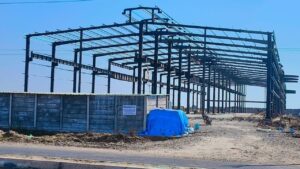
A Pre-Engineered Building (PEB) warehouse is a steel structure engineered with a tapered-column rigid frame system. Every component—primary members, secondary cold-formed members (Purlins/Girts), and cladding—is manufactured to millimeter precision in a factory.
Unlike conventional construction, PEB warehouses rely on Finite Element Analysis (FEA), resulting in optimized tensile usage and superior seismic performance.
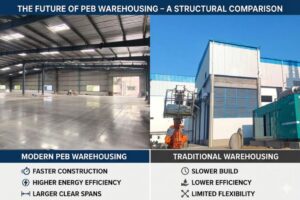
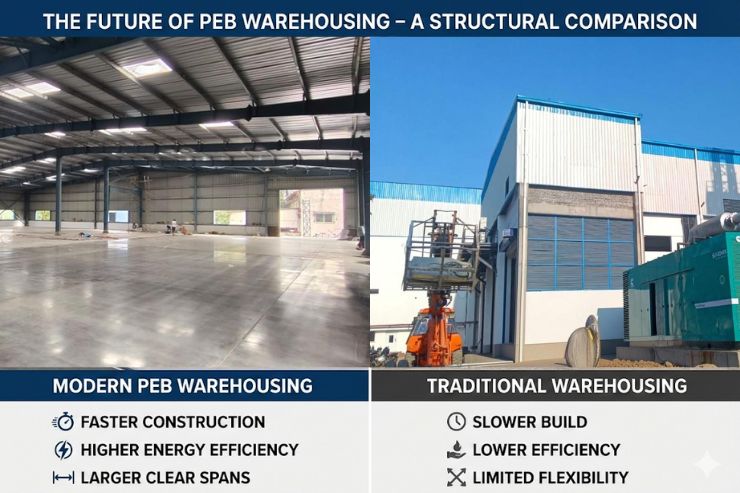
PEB v/s Traditional Warehouses: Technical Comparison
| Feature | PEB Warehouses | Traditional (RCC/Conventional Steel) |
| Structural Weight | 30% lighter due to high-strength steel (Grade 50/345 MPa). | Heavy self-weight increases foundation costs. |
| Clear Span Capabilities | Superior; ideal for unobstructed floor space. | Limited; requires frequent interior columns. |
| Foundation Design | Reduced footprint due to lower dead loads. | Massive foundations required for RCC frames. |
| Seismic Resistance | High ductility and flexible joints. | Rigid; prone to cracking under lateral stress. |
1. Construction Time
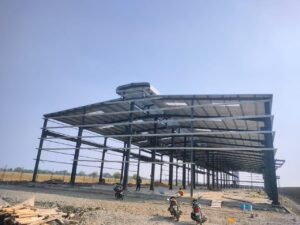
- PEB Warehouses: Construction is 30–50% faster because components are pre-fabricated. Parallel processing allows for foundation work and fabrication to happen simultaneously.
- Traditional Warehouses: Construction is sequential, dependent on wet-trade curing times and labor availability.
- Winner: PEB Warehousing
2. Cost Efficiency
- PEB Warehouses: Tapered members put steel only where stress dictates, reducing material cost. Fixed-price contracts minimize the risk of commodity price fluctuations during long build cycles.
- Traditional Warehouses: Higher material wastage and unpredictable labor overheads increase overall costs.
- Winner: PEB Warehousing
3. Environmental Adaptation & Limitations
While PEB is superior in most scenarios, it is critical to note that site conditions—such as restricted access for long-span trailers or extremely corrosive chemical environments—may require specialized coatings (e.g., Galvanization or Epoxy) or hybrid structural approaches.
Why the Future of PEB Warehousing Is Technically Strong
1. Growth of E-Commerce and High-Bay Logistics
PEB warehouses enable:
- Faster setup of fulfillment centers
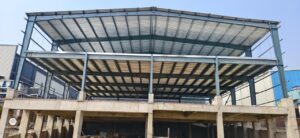
- Integration of Mezzanine floors for multi-level inventory
- Height-to-width ratios optimized for ASRS (Automated Storage and Retrieval Systems)
2. Sustainability and Thermal Performance
Modern PEB systems integrate Sandwich Panels (PIR/PUR/Rockwool) that significantly reduce HVAC energy loads. Furthermore, high-reflectivity (SRI) roofing aligns with global green building norms.
PEB Warehousing and Automation
Modern warehouses are adopting Robotic Handling. PEB warehouses provide the requisite floor flatness (FM2/Superflat) and large clear spans, making them ideal for integrating ASRS technologies.
Future Trends in PEB Warehousing
- BIM (Building Information Modeling) for 6D lifecycle management
- Solar panel–ready high-tensile roofs
- Hybrid structures combining PEB with heavy-duty RCC for heavy manufacturing zones
Conclusion: PEB Is the Future of Warehousing
When comparing PEB v/s traditional warehouses, the structural efficiency and reduced Total Cost of Ownership (TCO) of PEB structures clearly outweigh conventional methods. As businesses prioritize durability and speed, PEB warehouses are the strategic choice for long-term industrial assets.
Frequently Asked Questions
1. Is PEB warehousing an environmentally sustainable solution?
Yes, PEB warehousing supports green construction practices by using recyclable steel, minimizing material wastage, and enabling energy-efficient features like insulation and solar roofing systems.
2. Why are PEB warehouses better than traditional warehouses?
PEB warehouses offer quicker construction, lower overall costs, better design flexibility, easy expansion, and reduced maintenance, making them more efficient than traditional RCC warehouses.
3. Is PEB warehousing suitable for large logistics and e-commerce companies?
Yes, PEB warehousing is ideal for logistics and e-commerce companies because it supports large clear spans, high load-bearing capacity, automation systems, and rapid project execution.
4. How does PEB warehousing reduce construction time?
PEB warehouses are manufactured in a factory and assembled on-site, which significantly reduces on-site work, labor dependency, and delays caused by weather or material shortages.
5. Are PEB warehouses durable and safe for long-term use?
Yes, PEB warehouses are designed using advanced engineering software and high-quality steel, making them durable, earthquake-resistant, and capable of withstanding harsh weather conditions.
6. How does PEB warehousing support future expansion?
PEB warehouses are modular in design, allowing easy horizontal or vertical expansion without major demolition or operational disruption, making them future-ready.